Low-Carbon Fuels in BC
Low-carbon fuels have lower greenhouse gas emissions over their full life cycle, compared to petroleum-derived gasoline and diesel. Most of these fuels can be used in existing engines and infrastructure, enabling immediate emissions reductions. Learn about opportunities available in BC.
View / Download FileAccessible EV Charging Stations: Design Guidelines and Siting Criteria

This document references published guidelines and resources that may be particularly helpful to local governments as they plan accessible EV charger installations and summarizes the top considerations.
View / Download FileEV Charging in Multi-Unit Residential Buildings: Resources, policies, and programs to encourage and enable installation of EV chargers.

With the wealth of readily available resources and supportive programs, local governments can make it significantly easier for motivated community members to initiate and lead EV charging retrofits of their buildings. This document gathers the resources and materials that local governments can point community members to and summarizes key regulatory levers to consider.
View / Download FileFleet Forward Resource Guide
This listing shares tools, learning, connections and funding sources to help transition your fleet vehicles to zero-emissions.
Compiled and published by the Community Energy Association with funding and support from Natural Resources Canada, CleanBC, and BC Hydro.
View / Download FileHome Energy Retrofit Series: Electric Vehicles

Community Energy Association's Danielle Wiess will take us through all things electric vehicles.
Topics cover:
-
Electric vehicle charging,
-
Important install considerations,
-
Costing, and Incentive programs.
Thanks to support from Columbia Basin Trust, BC Hydro and FortisBC, these sessions are fully subsidized for participants from the Kootenay, Boundary and Columbia Basin regions.
View / Download FileEV Charger Installation at Heddleston Village, Nelson BC

A 24-unit residential development in the West Kootenays is now EV ready—and the number of electric vehicles has tripled—thanks to rebates to support infrastructure upgrades and some pro bono contributions from innovative residents.
View / Download FileEV Readiness Implementation Cohort - Summary Report 2023

The EV Ready Implementation Cohort was a pilot approach to support CEA’s Peer Networks in further advancing climate action in their communities. Implementation Cohorts are topical specific cohorts focused on the implementation of one shared priority where there is an existing commitment to adopt and implement.
View / Download File
Economic and technical contexts of electric vehicle-to-building bi-directional charging

To understand the value streams vehicle-to-building (V2B) can provide, it is essential to understand the scale of energy storage that EV batteries can offer with high EV adoption rates in British Columbia. This report was produced by Amaiya Khardenavis, UBC Sustainability Scholar, as part of the UBC Sustainability Scholars Program, a partnership between the University of British Columbia and various local governments and organizations in support of providing graduate students with opportunities to do applied research on projects that advance sustainability across the region.
This project was conducted under the mentorship of the Community Energy Association.
View / Download FileClass 2-4 Trucks Landscape in Canada
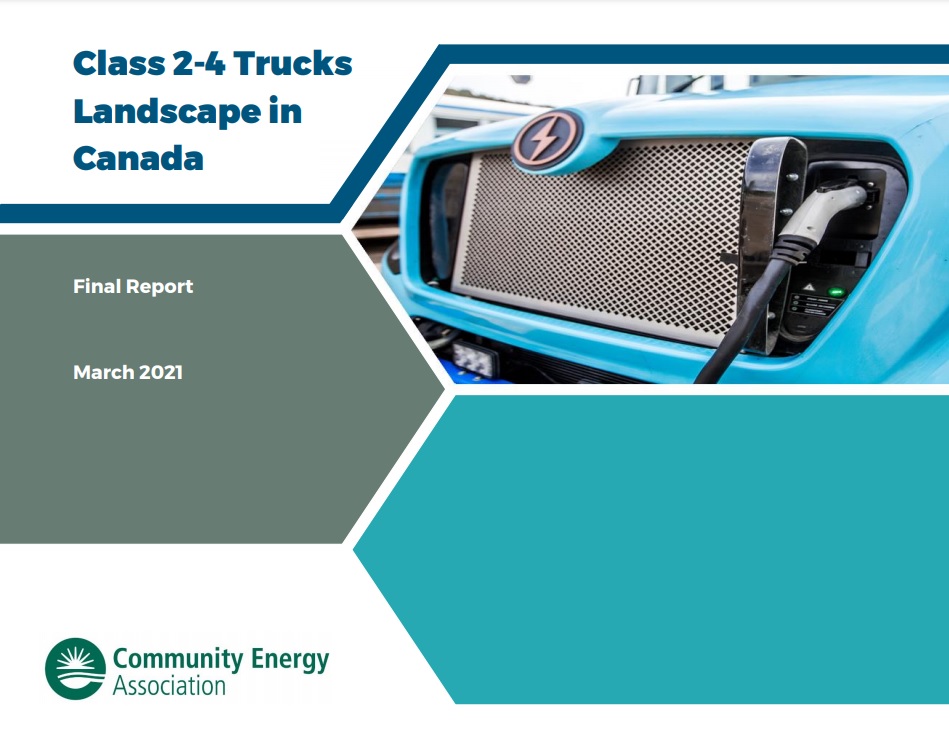
CEA researched how many medium duty vehicles (F250-F450 and equivalents) are registered across Canada, how many are used for various kinds of businesses, and where the opportunities are to reduce emissions in this sector.
The fleets in this sector are focused on electrification to deliver emissions reductions. We engaged with the vehicle registration entity in each province and obtained registration data for key provinces. The report identifies specific opportunities for Natural Resources Canada to support emissions reduction and highlights local government opportunities as well.
View / Download File