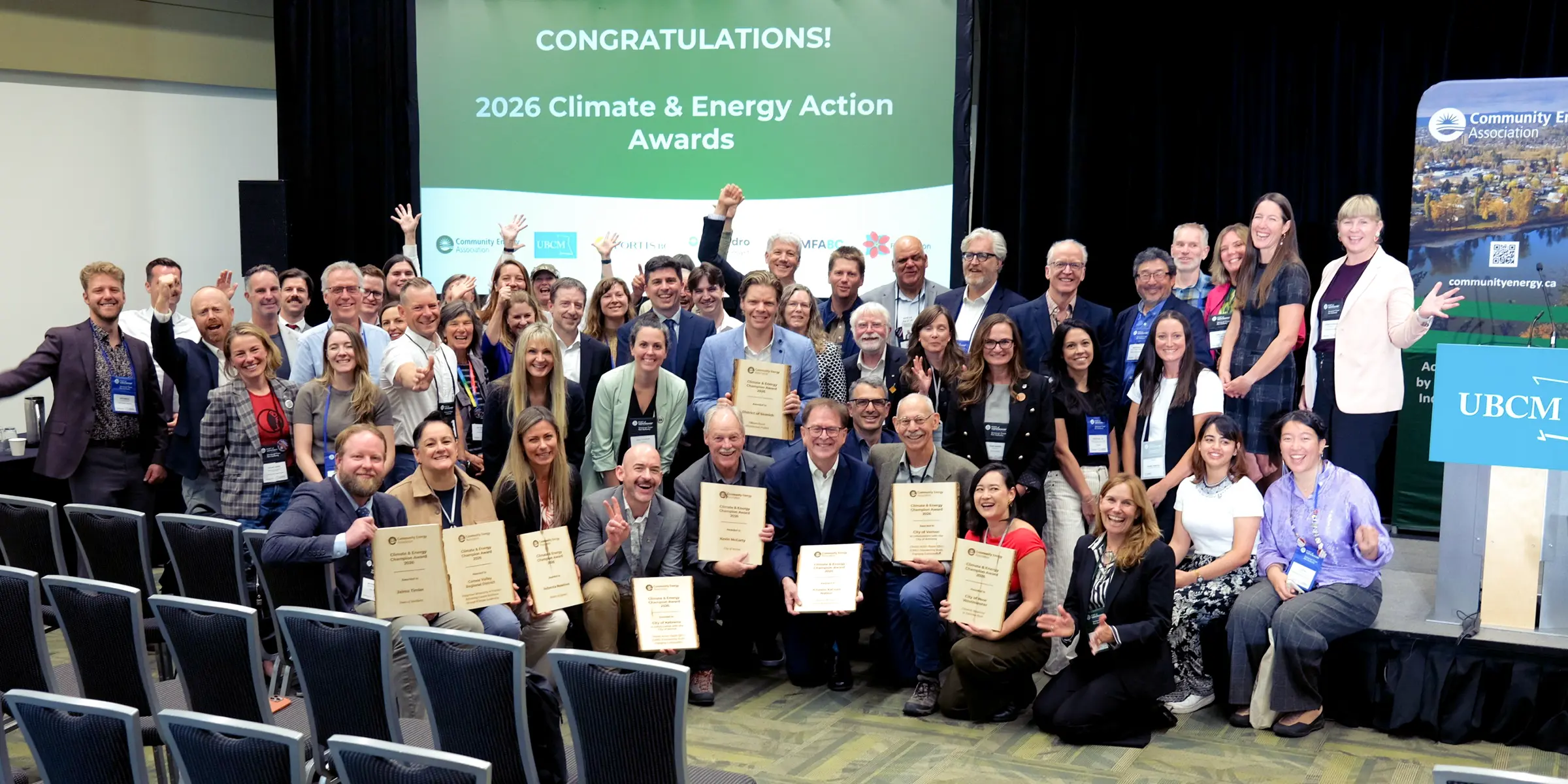
Awards celebrate local on-the-ground climate action
September 16, 2026
Community Energy Association (CEA) hosted the Climate & Energy Action Awards at UBCM in Vancouver on September 16, 2026, bringing together communities recognized for climate action excellence in the past year.
Since 1998, CEA has celebrated impactful projects and initiatives that translate community goals and ambition into on-the-ground change.
This year we brought together a team of our climate professionals from Community Energy Association (CEA) to judge the awards.
The 2026 Action Award nominees were: Comox Valley RD, Coquitlam, Kamloops, Kelowna, Kitasoo Xai'xais Nation, RD Kootenay Boundary, New Westminster, District of North Vancouver, Richmond, Saanich, Sqwah First Nation, Vernon, and Whistler!
For more information on each project visit our nominees page.
Climate & Energy Action award winners, nominees, and sponsors at the conclusion of the awards ceremony held during the Union of BC Municipalities convention, Sep. 16, 2026.
About CEA
The Community Energy Association accelerates bold action by local governments and Indigenous communities related to climate and energy. CEA grew from a committee established by the Government of BC and the Union of BC Municipalities in the 1990s, was incorporated as a non-profit in 2003, and registered as a charity the following year. CEA functions as a non-profit consultant with members and a Board of Directors; more than half of CEA’s member-organizations are local governments and Indigenous communities.
Climate & Energy Action Awards
Comox Valley Regional District and K’ómoks First Nation
Indigenous Witnessing in Practice: Reframing Coastal Resilience through K’ómoks Leadership
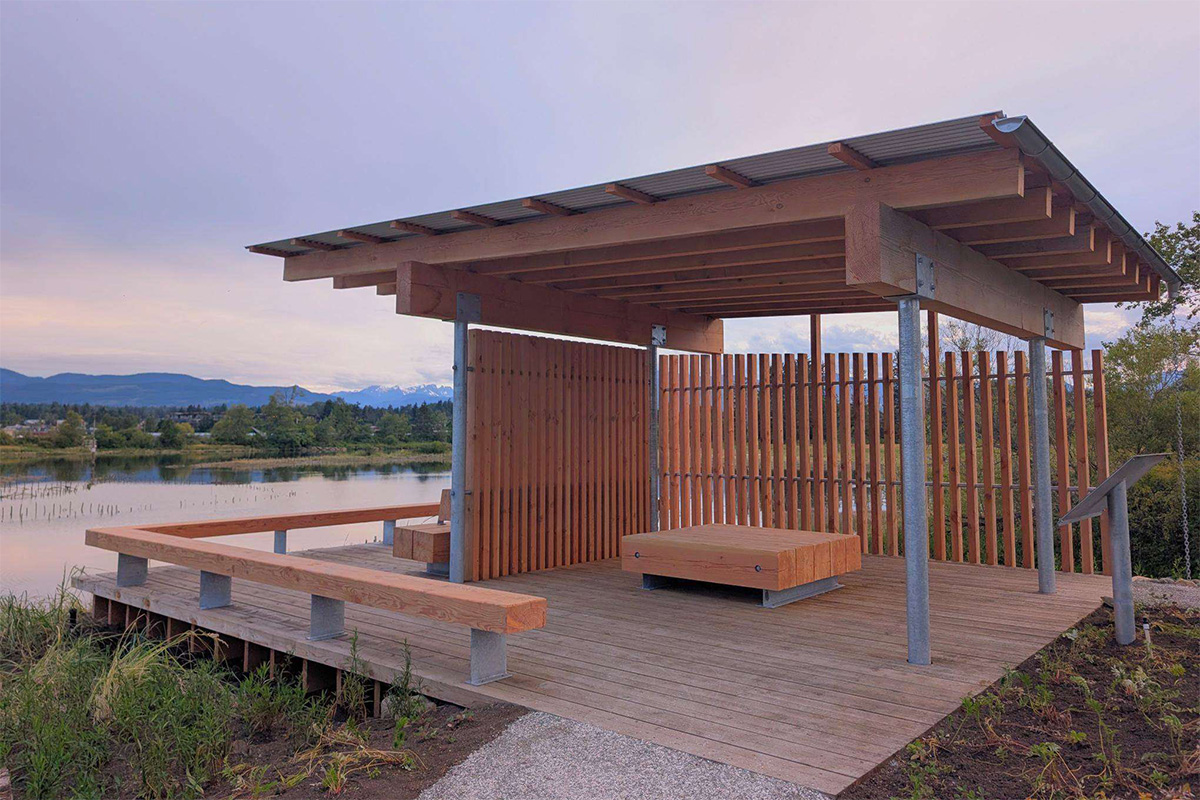
Comox Valley Regional District started developing a Coastal Flood Adaptation Strategy in 2019 to strengthen long-term resilience to sea level rise and coastal flooding. Their thoughtful approach to the project has also strengthened relationships with partners and brought far-reaching benefits to many areas of the community.
Building on earlier flood hazard mapping and risk assessments, the project brought together K’ómoks First Nation, local governments, provincial agencies, farmers, environmental organizations, and other regional partners to evaluate adaptation options, understand trade-offs, and develop a shared framework for action.
A defining feature of the project has been its culturally centred engagement process, which incorporated Indigenous witnessing to foster accountability, cultural safety, and respectful collaboration.
Judges’ comments:
“This project followed a highly collaborative process that was impressive in how it integrated Indigenous world views.
“This transformative way of working is very replicable to other communities and brings multiple co-benefits to every member of the partnership.”
Kitasoo Xai'xais Nation
Heat Pumps and Climate Planning

Kitasoo Xai’xais Nation is located in the remote, off-grid coastal community of Klemtu and has a vision of becoming the greenest community on BC’s central coast.
Heat pumps have replaced fossil fuel heating in 106 of the community’s 129 buildings since 2021, including 95 homes and 11 community spaces. The new heat pumps are powered by a local hydro plant that is owned by community itself, which means the cost of electricity can be kept low and the revenue from powering members’ homes stays local.
Judges’ comments:
“This is a powerful example of what can be done in small community when you have passion - you can be ambitious and nimble and really mobilize. There are real, immediate savings for members, and a long-term benefit to the community’s energy security.”
City of New Westminster
Citywide Response to Extreme Heat

Following the 2021 heat dome that claimed 619 lives in BC, the City of New Westminster launched a coordinated, cross-departmental initiative that has shifted its extreme heat response to focus on proactive, community-wide resilience.
New Westminster became the first city in Canada to adopt bylaws prohibiting landlords from restricting cooling equipment (2025) and requiring at least one safe overnight living space in occupied rental units (2026).
Judges’ comments:
“These measures will save lives. This is an incredibly comprehensive response that sends a strong signal to the community that addressing the impact of extreme heat is a priority for the City and that there are clear, practical ways protect residents.”
City of Vernon and City of Kelowna
Climate Action Ripple Effect (CARE) program
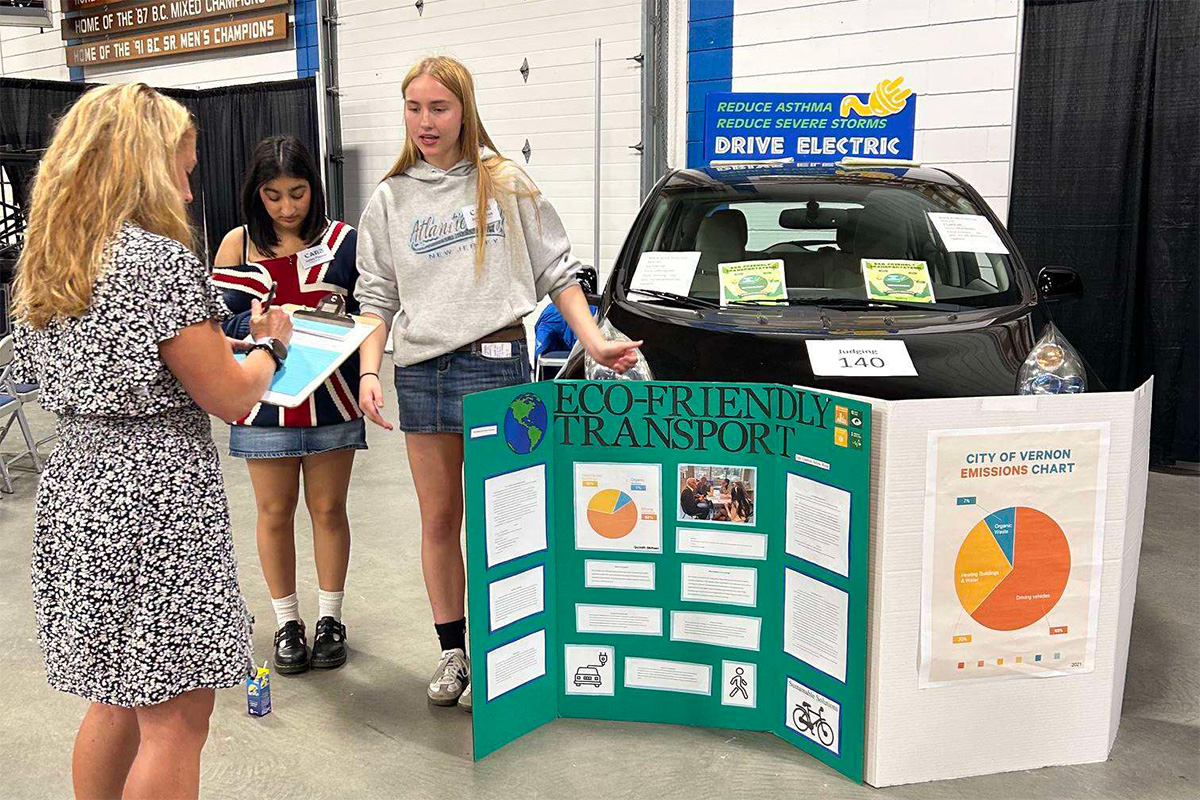
The Climate Action Ripple Effect (CARE) program empowers Grade 5-12 students across Vernon and Central Okanagan schools by matching them with real, community-based projects supported by mentors from multiple sectors, including the City of Vernon and City of Kelowna.
Students have the opportunity to learn, to apply that learning through tangible action, connect with community partners, and then share their work publicly, amplifying impact through networks, events, and media.
Judges’ comments:
“This program should be replicated in every school district in Canada. It is innovative and has such potential to make change in multiple areas over the long term. In ten years these kids will be voters and will enter the workforce with a good base of understanding around climate change initiatives in their community.”
District of Saanich
Tillicum Green Infrastructure Project
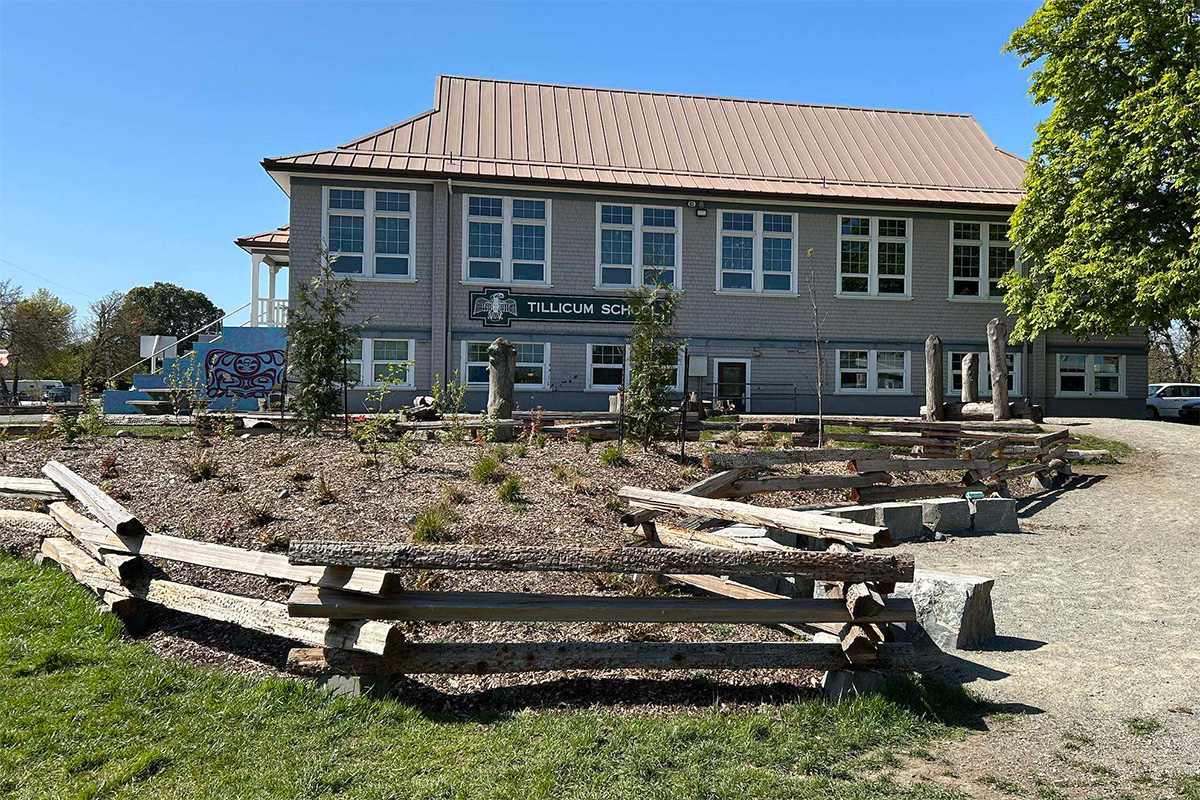
Saanich has been keen to enhance the climate adaptability of one of its neighbourhoods and worked with the school district and other partners to achieve it.
Their solution was rain gardens: a natural way to accommodate rainwater from paved surfaces while also providing shade and enhance biodiversity. Working with a local elementary school, more than a dozen rain gardens were added to the school grounds and the surrounding area, involving more than 100 trees and 1,200 shrubs.
Judges’ comments:
“Instead of approaching flood and heat purely as an engineering problem, Saanich used an equity lens for their climate risk assessment to identify the neighbourhood where people were most vulnerable and would benefit most.
“They then held many rounds of engagement, resulting in a project that has been shaped by the community with far-reaching social and resilience benefits.”
Climate & Energy Champions Awards New for 2026
New this year is a Champion award category to recognize and celebrate the leadership of staff from CEA member-communities; those who are often at the forefront of climate action and leading the way for the benefit of their communities.
The nominations that we received for the Champion award spoke to the personal dedication and wide range of skills and expertise that are demanded of individuals working in climate action in 2026.
Two of the three Champion award winners also picked up an Action Award for a project within their community. Clearly, having award-winning leadership also translates to implementing award-winning projects!
Jaima Timler
Climate Action Specialist, Town of Smithers

Jaima is always up front making sure a climate action project is successful, whether the project involves Hydrogen fuel enhancements on heavy duty equipment, decommissioning the gas meter at Smithers Town Hall or participating in the annual Earth Week bike parade.
She has successfully applied for grants or private partnerships to fund many of Smithers’ Community Energy and Emissions Plan’s implementation projects and has also lobbied the province to continue LGCAP funding so that small communities like Smithers continue to have resources to employ a Climate Action Specialist like her.
Judges’ comments:
“Jaima is passionate about achieving climate action goals established by the Town and she uses that energy to motivate municipal staff and the community alike to embrace climate action initiatives.
“It is clear from the wide scope of projects mentioned in the nomination that Jaima goes well beyond her job description to pursue ambitious goals that will bring real, long-term changes to her community.”
Rebecca Newlove
Manager of Sustainability, District of Saanich

For nearly ten years, Rebecca Newlove has led the sustainability division at the District of Saanich. This has involved leading the development of “100% Renewable and Resilient Saanich,” the District’s award-winning climate plan. She recently led an update to that plan and has been collaborating with colleagues and the broader community on such initiatives as the Tillicum Green Infrastructure Project and the municipality’s asset management program.
Judges’ comments:
“It’s clear that Rebecca’s passion and commitment to climate action and sustainability have propelled Saanich into its enviable place as a leader among Canadian municipalities. She is the kind of champion that these awards really celebrate: collaborative and dedicated, while demonstrating the perseverance and long-term thinking that gradually move a community to implementing actions that truly benefit every resident.”
Kevin McCarty
Climate Action Specialist, City of Vernon

Kevin McCarty integrates meaningful climate solutions into the City of Vernon’s operations and practices. This includes serving as staff liaison for Vernon Council’s Climate Action Advisory Committee and applying a greenhouse gas emission calculator he created to assess the financial impact of specific climate actions.
His greatest contributions may be in how collaborates with local organizations that build capacity for climate action and resilience across the region. The proposed Climate Engagement Centre, the Land 2 Table food security project, and the expansion of youth involvement with FireSmart activities are all examples of his influence and impact. In fact, he is significantly building local capacity by creating 13 climate-related jobs, both in the City and the Youth Climate Corps.
Judges’ comments:
“What makes Kevin’s nomination stand out is his ability to have an impact both within the local government and the community at large. His mentorship and support of youth is particularly noteworthy; so many communities want to engage with youth, and Kevin is actually doing it.”
About the Climate & Energy Action Awards
Community Energy Association (CEA) has been presenting the Climate & Energy Action Awards for nearly three decades. Over that time, the awards have showcased innovative projects that have translated community ambitions into on-the-ground initiatives that benefit residents.
This year we brought together a team of CEA climate professionals to evaluate applications and identify the standout initiatives. For more information on this year’s nominations, visit our nominees page.
Thank you to the sponsors who make these awards possible: BC Hydro, FortisBC, the Municipal Finance Authority of BC, the Real Estate Foundation of BC, and the Union of BC Municipalities.
