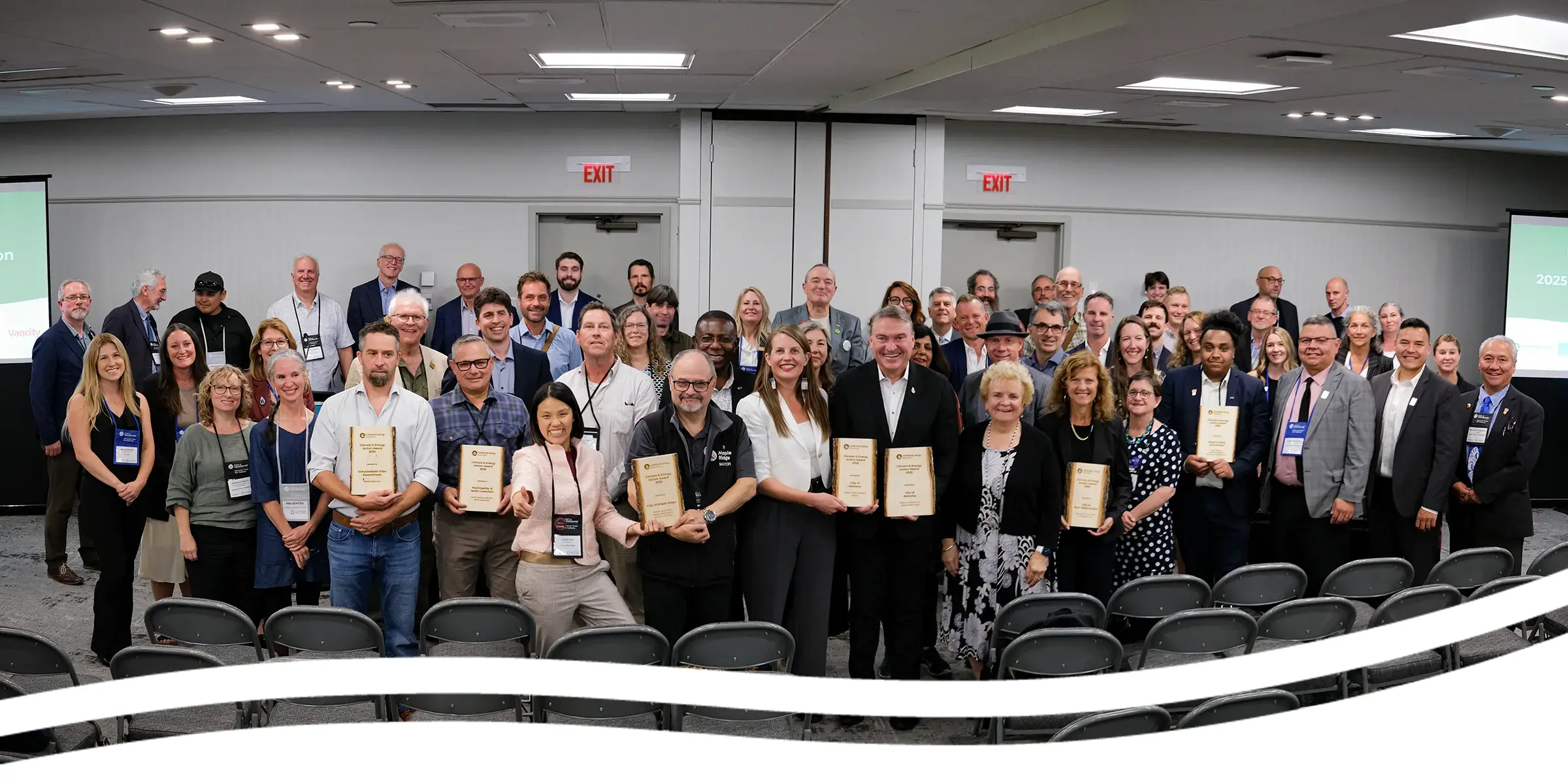
Climate & Energy Action Awards
Thank you to everyone who submitted a nomination for this year’s Climate & Energy Action Awards! Applications are now closed, and our judging panel is now reviewing all applications against the eligibility and judging criteria outlined below. Nominees will be announced in our August 2026 Newsletter – stay tuned!
Questions?
For any inquiries about the Climate & Energy Action Awards, email awards@communityenergy.ca.
Award Categories
The Climate & Energy Action Awards recognize outstanding projects, initiatives and programs driving climate action across BC. Nominations are evaluated on their contribution to community resilience, reduction or projected reduction of greenhouse gas emissions, and the broader co-benefits positioning communities for success.
Eligibility
The Action award is open to all municipalities, regional districts, and Indigenous communities in BC. Applicants can submit more than one application per year, however, only one application will be advanced to the shortlist for judging. More than one community can apply together. Each application should be for one specific action. To be eligible for consideration, actions:
- Cannot be the subject of an application that was previously awarded a Climate & Energy Action Award.
- Must be at a stage where CEA can publicly talk about the action through Awards communications. All submitted content may be used in CEA communications to highlight best practices.
- Should focus on implementation and should have measurable results.
- Must have had some stage/milestone of the action completed sometime from January 1, 2025 to the present.
Judging Criteria
- Reduction in greenhouse gas emissions and energy consumption
- Resilience to climate impacts
- Co-benefits and contribution to community well-being
- Culture and commitment
- Replicability and evidence of innovation
The Climate and Energy Champion Awards recognize staff and elected officials of local governments and Indigenous communities who demonstrate strong personal commitment to advancing climate action and resilience within their organization. Only individuals who work for a CEA member community are eligible for a Champion award.
This award celebrates people who lead by example—taking initiative, influencing others, and helping integrate meaningful climate solutions in their organizations and communities. The award is granted to three types of recipient—an acknowledgement that progress depends, not only on technical solutions, but on people at every level to champion change and maintain momentum within their spheres of influence.
Structure
The Champion Award is open to individuals in any of the following 3 categories. One winner will be selected for each category.
- Staff Champion: recognizes staff members who lead or advance climate action through their day-to-day work.
- Senior Leadership Champion: recognizes members of executive or senior leadership who enable and accelerate climate action across the organization.
- Elected Official Champion: recognizes elected officials who provide visible, consistent leadership that supports staff capacity and decision-making related to climate, energy, and resilience priorities.
Eligibility
The Climate & Energy Champion Awards are open to CEA member municipalities, regional districts, and Indigenous communities only in BC. Applicants can self-nominate or may nominate more than one individual for a specific category. To be eligible for consideration:
- Nominees must be from a CEA member community.
- Any related initiatives must be at a stage where CEA can publicly talk about their efforts through Awards communications. All submitted content may be used in CEA communications to highlight leaders.
- Nominees must still be an elected official or staff member at the CEA Member organization at the time of nomination.
Judging Criteria
- Decisions or actions have led to meaningful changes in their organization and/or community.
- Decisions or actions have increased conversations or awareness of climate solutions.
- Leadership has inspired others.
- Demonstrated commitment to inclusive and equitable climate and energy action.
- Demonstration of strong personal commitment to climate action.
- Noticeable and sustained contribution to collaborative climate action.
Note: Eligibility adjusted on May 29, 2026. Self-nominations are welcome and there is no longer a time limit on when nominees' actions took place.
Key Dates
- Call for nominations
May 25, 2026
- Deadline for nominations
July 13, 2026
- Nominees announcement
Aug. 3, 2026
- Awards ceremony
Sept. 16, 2026
Shortlisted nominations will be profiled in the August edition of CEA's email newsletter (subscribe if you haven’t already). The winners will be announced at the Union of BC Municipalities convention in September.
About the Climate & Energy Action Awards
Celebrating Climate Work at the Local Level
We’ve heard that “local governments are on the front lines of climate action” (CleanBC Roadmap to 2030) and that “cities are on the leading edge of climate action” (C40 Cities Climate Leadership Group), but sometimes communities are challenged to balance climate action with myriad other responsibilities. Further, knowing what needs to be done to reduce local greenhouse gas emissions can be very different from actually implementing solutions. In these cases, sharing and amplifying the practical experiences of other communities is invaluable.
This is why it’s so important to celebrate success.
The Community Energy Association has been running the Climate & Energy Action Awards in BC since the 1990s. We have recognized a wide variety of local government climate action initiatives across all four of BC’s distinct climatic zones. These unique awards recognize climate leadership by communities large, small, and everything in between. Winners have included the City of Vancouver, the Village of Granisle with only about 300 residents, the Town of Ucluelet in the wild Pacific Coast, and the City of Dawson Creek in the the Province’s northeastern corner.
The projects communities have implemented are equally diverse, ranging from OCP initiatives and other strategic plans to district energy systems, energy efficiency upgrades in civic facilities, transportation projects, retrofit initiatives, and more.
Over the years, awards nominations have formed a true treasure trove for one simple reason: they demonstrate local success. Before they are ranked by judges and before winners are selected, these submissions prove that the real reward for climate action is fewer greenhouse gas emissions.
Our Commitment to Truth and Reconciliation
CEA is honoured to celebrate with communities and is committed to the principles of Truth and Reconciliation. As an organization, we support the Calls to Action released by the Truth and Reconciliation Commission of Canada and recognize the importance of the self-determination of Indigenous Peoples as articulated in the United Nations Declaration on the Rights of Indigenous Peoples. Learn more here.
Looking for Inspiration?
Learn more about the Previous Winners & Nominees
Over the years, the Community Energy Association has invited municipalities, regional districts, and Indigenous communities around BC to nominate local projects and initiatives for a Climate & Energy Action Award. You can also see past nominees and winners in the BC Community Climate Action Dashboard.
See the summaries of ALL 25 NOMINEES for the 2023 Climate & Energy Action Awards
Winners
Watch the videos of the winners of the 2022 Climate & Energy Action Awards
Nominees
In 2022, CEA celebrated seventeen nominees for the Climate & Energy Action Awards. The nominees were:
Greater Victoria District 2030 – The City of Victoria and the District of Saanich are working with the owners/managers of 37 local commercial buildings to meet new targets for energy consumption and greenhouse gas emission reduction.
Kamloops Big Move Investments – In order to fund priorities in the new Kamloops Climate Action Plan and to reduce local GHG emissions, the City has implemented a Climate Action Levy of 0.35% on its civic tax roll, providing an estimated $24 million in funding over the next 10 years.
Kelowna 2040 – In combining its long-term transportation and community land use plans, Kelowna 2040 is shaping how the community will grow, commute, and interact – ultimately helping in the transition to a low-carbon community that is resilient to the impacts of climate change.
City of Nelson’s Material Carbon Emissions Guide – Developed as a resource for municipal staff, builders, homeowners, and others, this guide provides information and easy-to-understand graphics comparing the embodied emissions associated with different types of materials (such as concrete, insulation, and cladding) and the importance of considering embodied emissions as a part of building design and planning.
New West’s Seven Bold Steps – Subsequent to declaring a climate emergency, the City of New Westminster rolled out Seven Bold Steps for Climate Action that serves as a manifesto for the City and its residents, and led to a Climate Action Budgeting Framework that helps to actualize the goals of the Seven Bold Steps.
Penticton Blue Skies Public Engagement for Climate Action – Following a hot and smoke-filled summer, the City of Penticton conducted a public engagement campaign called ‘Blue Skies’ to gain feedback on the City’s draft Community Climate Action Plan. It involved engaging with more than 500 young people between grades 3-12 in five local schools, ultimately leading to more ambitious local targets than had been initially proposed.
Powell River Zunga Bus and Transit Analysis – Challenged with the vicious cycle of low ridership leading to unattractive transit service, Powell River implemented an on-demand, micro-transit service that complemented some of the existing transit routes in order to reduce wait times and increase service speed and frequency.
Surrey EV Infrastructure Analysis – This project takes a neighbourhood approach to electric vehicle charging infrastructure, incorporating various data – population, zoning and housing types, future development, vehicle ownership, EV adoption, travel patterns, etc. – and financial analysis to determine optimum locations for public charging to support EV adoption and achieve GHG reduction targets.
Tofino Electric Summer Shuttle – Operating since 2008 to transport visitors from Tofino to a popular nearby beach area, the diesel-burning Summer Shuttle has been replaced by an electric bus, resulting in a quieter, zero emissions service that has removed nearly nine tonnes of carbon emissions.
Vernon Climate Action Plan – Recognizing that many initiatives to reduce local greenhouse gas emissions rely on the participation of residents, Vernon recruited 30 local Climate Ambassadors who were trained to approach climate change with plain language and facilitate climate conversations within their own organizations and networks.
Retrofit Assist in Squamish and Whistler – Serving as a concierge connecting homeowners, energy advisors, and contractors, this pilot project in Squamish and Whistler aims to make it easy for residents to swap out fossil fuel heating systems for an electric heat pump and consequently reduce emissions and make homes healthier. More than 50 inquiries were received in the first week following the program's launch.
Port Moody Low Carbon Resilient Climate Action Plan, Phase One Implementation Strategy, and Annual Report – After completing a climate action plan that incorporates both greenhouse gas mitigation as well as climate change adaptation in a low-carbon resilience framework, Port Moody has produced its first Climate Action Report, highlighting progress on implementation of the Plan’s priority actions.
District of West Vancouver Foreshore Development Permit Area and Sea Level Rise Adaptation Policy – As climate change causes increased risk of sea level rise and coastal flooding, West Vancouver has adopted guidelines that require new homes to be built at an elevation above the risk of coastal flooding, minimizing the risk to people and their homes while protecting the natural foreshore environment.
UBC Future Climate Residential Building Design Requirements – New residential buildings at the Point Grey campus are now required to be able to maintain comfort and safety under summer climate conditions that are predicted to increase over the next three decades because of climate change. The “2050 Future Climate-Ready” resources and future weather models are available to communities around the province.
Lhoosk'uz Dené Nation Community Leadership in Climate Change Adaptation, Bioenergy, and Bioeconomy – Located nearly 200km west of Quesnel, Kluskus Indian Reserve #1 is reliant on trucked-in fossil fuels for heat and electricity and surrounded by wildfire risk posed by the mountain pine beetle infestation. In response, the Nation is aiming to utilize available forest resources to provide power and heat for the community, reducing GHG emissions while creating energy independence and new economic opportunities.
BC First Nations Climate Strategy and Action Plan – The First Nations Leadership Council established a first-of-its-kind Climate Strategy and Action Plan. Published in the spring of 2022, the plan outlines a vision, five guiding principles, four priority pathways for climate action, and 20 urgent calls for climate action–all recognizing that Indigenous Peoples and their traditional territories are disproportionately affected by climate change more than any other group in Canada.
City of Victoria Green Fleet Plan – In order to achieve a 60% reduction in emissions from the City of Victoria’s fleet of more than 400 vehicles, the City will electrify 143 vehicles over the next nine years and identify underutilized vehicles that can be removed from the fleet or even be replaced with pooled electric vehicles or electric cargo bikes.
Thank you to the sponsors of CEA's Climate & Energy Action Awards
Thank you to the sponsors of the Climate & Energy Action Awards program: Union of BC Municipalities, BC Hydro and Municipal Finance Authority of BC.

